
Dental coding is the use of standardized codes in claim submission forms to represent dental procedures, enabling insurance companies to identify procedures and process claims accordingly.
In this article, we’ll explore all the essentials of dental coding, including how it works, common pitfalls, and best practices. It’s a practical and easy-to-understand guide designed as a valuable resource for your dental care providers, billing staff, and practice managers.
What Are CDT Codes and How Do They Work?
Dental coding heavily relies on the CDT codes, and it’s important to know what these are and how they are applied, so you accurately enter codes for each procedure while filing claims.
CDT Coding Fundamentals
The principal code set used in dentistry is the Current Dental Terminology (CDT), published annually by the ADA. Here are the coding fundamentals you must know while entering codes for dental procedures.
- Code Structure: CDT codes use a standard 5-character format: letter “D” + four digits (e.g., D1110, D2740, D4341)
- Precise Definitions: Each CDT code has a specific definition that describes procedure intent, included components, and qualification details (e.g., surfaces, units).
- Correct Coding: Always code exactly the procedure that’s performed. There must be no downcoding or adjusting for payer coverage.
- Documentation Support: Documentation must match the code: clinical notes, radiographs, photos, perio charting, and narratives when needed.
- Bundled Services: Some codes include components like anesthesia, suturing, or irrigation. These cannot be billed separately.
- Authorization Limits: Many codes require prior authorization or have frequency limits (e.g., prophy: 1-2 times per year, scaling and root planning: 24-36 months).
- Strong Narratives: Clear and concise narratives reduce claim denials, especially for scaling and root planning, night guards, and procedures requiring prior authorization.
- Category Ranges: CDT covers all the categories of dental care, as explained in the table below.
| Code Range | Procedure Range | Explanation |
|---|---|---|
| D0100–D0999 | Diagnostic | Exams, evaluations, and imaging to assess oral health, e.g., D0120 (periodic oral evaluation) |
| D1000–D1999 | Preventive | Routine preventive care to keep teeth/gums healthy, e.g. D1110 (adult prophylaxis/cleaning) |
| D2000–D2999 | Restorative | Repair or restore damaged teeth (fillings, crowns, etc.), e.g., D2330 (resin-based composite, one surface, anterior) |
| D3000–D3999 | Endodontics | Treatments dealing with dental pulp/root canal issues, e.g., D3310 (root canal therapy, anterior tooth) |
| D4000–D4999 | Periodontics | Procedures for gum and supporting tissue health, e.g., D4341 (scaling and root planing for four or more teeth per quadrant) |
| D5000–D5899 | Removable Prosthodontics | Removable dentures/partials to replace missing teeth, e.g., D5213 (partial denture for metal base, resin denture) |
| D5900–D5999 | Maxillofacial Prosthetics | Prosthetics for facial/oral structures beyond teeth (e.g., after surgery/trauma), e.g., D5999 (unspecified maxillofacial prosthesis, by report) |
| D6000–D6199 | Implant Services | Placement or maintenance of dental implants, e.g., D6010 (surgical placement of implant body) |
| D6200–D6999 | Fixed Prosthodontics | Non-removable restorations like crowns, bridges, e.g., D6241 (pontic in a fixed bridge made of porcelain fused to metal) |
| D7000–D7999 | Oral and Maxillofacial Surgery | Extractions, surgical removal, or other oral surgery, e.g, D7140 (extraction of an erupted tooth or exposed root) |
| D8000–D8999 | Orthodontics | Procedures for correcting bite/misalignment, e.g., D8080 (comprehensive orthodontic treatment for adolescents) |
| D9000–D9999 | Adjunctive Services | Miscellaneous/additional services not covered elsewhere, e.g., D9110 (palliative (emergency) treatment of dental pain) |
How Accurate Coding Benefits Your Practice
Using accurate CDT codes for each dental procedure is an essential component of your entire dental billing and coding process. Doing so helps:
- Ensure insurance claims are properly processed. Insurance companies rely on CDT codes to review your claims.
- Prevent claim denials or delays caused by outdated or incorrect codes. For example, using a retired code from a previous year can trigger rejection.
- Maintain clear and standardized patient records. CDT codes and descriptors provide a standardized explanation for treatment records, audits, and reporting.

CDT Updates
The CDT codes are updated annually by the ADA’s Code Maintenance Committee (CMC). These updates include:
- New codes for emerging procedures or technologies.
- Revised descriptors for clarity or accuracy.
- Deleted codes that are outdated or no longer in use.
Billers must follow updated CDT code lists for precise coding procedures.
Now, for instance, ADA has announced its upcoming CDT 2026 update for the next year. It has 60 updates, including 31 new codes, 14 revisions, 6 deletions, and 9 editorial changes, effective from January 1, 2026.
Based on that, we’ll describe the major CDT changes your billers must follow in 2026.
First, let’s discuss the codes that are deleted and no longer in practice.
| CDT Code | Description | Notes |
|---|---|---|
| D1352 | Preventive resin restoration: permanent tooth (moderate-high caries risk) | Merged into D2391. All one-surface posterior composite restorations now use D2391. |
| D1705 | AstraZeneca COVID-19 vaccine: first dose | COVID-vaccine-related codes have been mostly removed from CDT 2026. |
| D1706 | AstraZeneca COVID-19 vaccine: second dose | |
| D1707 | Janssen COVID-19 vaccine: first dose | |
| D1712 | Janssen COVID-19 vaccine: booster dose | |
| D9248 | Non-intravenous conscious sedation | Replaced by revised anesthesia/sedation codes under the new anesthesia code overhaul. |
Now, in the next table, we’ll discuss new additions to the CDT code sets.
| CDT Code | Description | Notes |
|---|---|---|
| D0426 | Collection, preparation, and analysis of saliva sample – point-of-care | Diagnostic code for in-office saliva testing. |
| D0461 | Testing for cracked tooth | Testing multiple teeth (e.g., transillumination, staining) to locate cracks or exclude other causes. |
| D1720 | Influenza vaccine administration | Vaccine administration (flu). |
| D5877 | Duplication of complete denture – maxillary | Creates a duplicate maxillary denture for backup or interim use during repair/modification. |
| D5878 | Duplication of complete denture – mandibular | Duplicate mandibular denture for interim or backup use. |
| D5909 | Maxillary guidance prosthesis with guide flange | Guides mandibular movement after resection, trauma, or surgery; improves occlusion. |
| D5930 | Maxillary guidance prosthesis without guide flange | Stabilizes jaw function without a guide flange post-surgery. |
| D5938 | Resection prosthesis, maxillary complete removable | Removable full-arch prosthesis restoring function and aesthetics post-resection. |
| D5939 | Resection prosthesis, mandibular complete removable | Restores mandibular function and appearance after surgical resection. |
| D5940 | Resection prosthesis, maxillary partial removable | Removable partial prosthesis after maxillary resection. |
| D5941 | Resection prosthesis, mandibular partial removable | Partial removable prosthesis for mandible post-resection. |
| D5942 | Maxillary implant-supported removable resection prosthesis – edentulous | Implant-supported full-arch removable prosthesis after maxillary resection. |
| D5943 | Mandibular implant-supported removable resection prosthesis – edentulous | Implant-supported removable full-arch prosthesis for mandible. |
| D5944 | Maxillary implant-supported removable resection prosthesis – partial | Partial implant-supported removable prosthesis post-resection. |
| D5945 | Mandibular implant-supported removable resection prosthesis – partial | Partial removable implant prosthesis for mandible. |
| D5946 | Maxillary implant-supported fixed resection prosthesis – partial | Fixed implant-supported prosthesis after maxillary resection. |
| D5947 | Mandibular implant-supported fixed resection prosthesis – edentulous | Fixed full-arch mandibular implant prosthesis post-resection. |
| D5948 | Maxillary implant-supported fixed resection prosthesis – partial | Fixed partial maxillary prosthesis on implants. |
| D5949 | Mandibular implant-supported fixed resection prosthesis – partial | Fixed partial mandibular implant prosthesis. |
| D6196 | Removal of an indirect restoration on an implant-retained abutment | Allows removal for maintenance, repair, or evaluation. |
| D6280 | Implant maintenance procedure – full-arch removable | Removal and reinsertion of full-arch implant prosthesis per arch. |
| D9128 | Photobiomodulation therapy – first 15 minutes | Adjunctive light therapy to reduce pain, inflammation, or accelerate healing. |
Now let’s review the revised descriptors in the 2026 updates.
| CDT Code | Description | Notes |
|---|---|---|
| D2391 | Resin-based composite – one surface, posterior | Descriptor revised: removed dentin penetration requirement; now applies to all one-surface posterior composites. |
| D0180 | Comprehensive periodontal evaluation – new or established patient | Descriptor updated to emphasize full-mouth evaluation for patients with periodontal or special risk indicators. |
| D9230 | Administration of nitrous oxide | Revised to specify nitrous oxide as a single agent; part of anesthesia code overhaul. |
| D5876 | Add metal substructure to acrylic complete denture – per arch | Descriptor clarified to define scope during denture fabrication or repair. |
| D5934 | Mandibular guidance prosthesis with guide flange | Descriptor revised to clarify scope and clinical indications. |
| D5935 | Mandibular guidance prosthesis without guide flange | Descriptor revised for clarity. |
| D7285 | Incisional biopsy of oral tissue – hard (bone/tooth) | Revised to specify intra-osseous lesions such as cysts or tumors. |
| D7286 | Incisional biopsy of oral tissue – soft | Descriptor revised to clarify scope of soft tissue biopsies. |
How Does the Dental Coding Process Work: Step-by-Step Guide
Coding a dental procedure isn’t just about choosing a code and entering it into the claim form. It’s a complete process that dental billers must follow to ensure accuracy, compliance, and proper documentation for speedy and complete claim reimbursements.
These are the following steps:
- Reviewing the payer-specific coding requirements
- Selecting the appropriate CDT code for each procedure
- Code for procedures without exact matches in CDT code lists
- Handle multiple procedures / comprehensive visits
- Add modifiers to requirements
- Cross-code with medical coding for medically necessary dental procedures
- Reviewing documentation requirements for CDT coding
- Submitting insurance claims
- Tracking coding errors and rectifying mistakes in case of claim denials
Review the Payer-Specific Coding Requirements
CDT codes standardize dental procedure names, but they can’t guarantee coverage or payment by the insurers.
The reason is that payers decide which CDT codes they cover, how often, and under what circumstances.
For example, some payers may cover D1110 (adult prophylaxis) only twice per year, while D1999 (unspecified preventive) may require prior authorization.
Similarly, a payer may cover D1355 (caries-arresting medicament) only for patients under 18, and if a coder uses this code for a procedure on adults without checking the payer requirements, it results in a straight claim denial.
Policies vary per insurance company, so you must review the codes your payer accepts and entertains. It helps you enter the correct codes beforehand, reducing effort and saving time for your staff.
Select the Appropriate CDT Code
The dentist determines what services are provided to a patient, which includes all the key details, such as:
- Type of procedure
- Tooth number
- Surfaces
- Materials
Following that, a dentist is responsible for choosing the appropriate code from the CDT code list for every dental procedure. This code entry consists of a code, nomenclature, and descriptor (if applicable).
For example, if a dentist performs a routine adult cleaning, the exact CDT code entry they must choose for billing is as follows:
- Code: D1110
- Nomenclature/Category: Preventive
- Descriptor: Prophylaxis – Adult
The billing team must verify the code, nomenclature, and descriptor, if these are accurate and match the updated CDT code list, before submitting claims.
Doing so ensures that the payer knows exactly what procedure is performed and can process the claim correctly.
Note: Avoid entering a code that may offer you higher reimbursements, but isn’t accurate, as this can lead to claim denials, and even audits and legal complications for your practice. Therefore, you must use the right code.
Code for Procedures without Exact Matches
If there’s no exact match, use an “unspecified … by report” code (e.g., D1999 unspecified preventive procedure), but accompany it with reasoning and detailed documentation describing the procedure for proper justification.
For example, a custom fluoride varnish application combined with oral hygiene instruction for a patient with special needs doesn’t fit any of the standard CDT preventive codes.
In that case, you can code it as D1999 and describe all the details, while also mentioning that you’ve selected this code, as there isn’t any available appropriate code for it in the list.
The table below describes some of the most common “unspecified / by report CDT codes”.
| CDT Code | Category | Purpose |
|---|---|---|
| D0999 | Diagnostic | Unspecified diagnostic procedure used when no existing diagnostic code applies. |
| D1999 | Preventive | Unspecified preventive service requiring a narrative explanation of the procedure. |
| D2999 | Restorative | Used for restorative services involving new materials or techniques not yet assigned a specific code. |
| D3999 | Endodontics | Unspecified endodontic procedure when treatment does not match existing endo codes. |
| D4999 | Periodontics | Unspecified periodontal procedure used for specialized therapies not otherwise listed. |
| D5899 | Removable Prosthodontics | Unspecified procedure related to removable prosthetic services. |
| D5999 | Maxillofacial Prosthetics | Unspecified maxillofacial prosthetic service. |
| D6199 | Implant Services | Unspecified implant-related service or procedure. |
| D6999 | Fixed Prosthodontics | Unspecified fixed prosthetic procedure. |
| D7999 | Oral & Maxillofacial Surgery | Unspecified oral or maxillofacial surgical procedure. |
| D8999 | Orthodontics | Unspecified orthodontic service. |
| D9999 | Adjunctive Services | Unspecified adjunctive procedure. |
Handle Multiple Procedures / Comprehensive Visits
Many patient visits involve more than one service, such as cleaning, filling, and X‑rays. Each service should be coded individually, with:
- Appropriate modifiers (if required)
- Tooth numbers/surfaces
- Supporting documentation
While doing so, avoid unbundling or billing component services separately when a single CDT code defines them as part of a comprehensive service.
For example, if a dentist places a resin-based composite filling on an anterior tooth, the comprehensive code for a single-surface restoration is D2330 (resin-based composite, one surface, anterior).
Here, it’s unbundled, if you bill the following three separately:
- D2330 (Resin-based composite, one surface)
- D2391 (Additional surface on the same tooth)
- D2740 (Crown preparation)
And this is incorrect if the dentist only does a one-surface composite filling, because everything needed for that procedure is already included in D2330. Therefore, it can’t be billed separately. You must bill it together in one code.
Add Modifiers Upon Requirement
Modifiers are short two-digit codes added to a CDT code to indicate special circumstances, multiple surfaces, or exceptions, helping clarify the procedure performed on a patient. Certain dental procedures can require these modifiers to present a clearer picture to the payer.
Currently, ADA and the Centers for Medicare & Medicaid Services (CMS) accept only two modifiers in CDT coding. These are:
| Modifier | Meaning | When to Use It | Example |
|---|---|---|---|
| KX | Indicates the dental service is linked to a medical procedure and is medically necessary. | Use for each procedure when dental work is required due to a medical condition or treatment covered by Medicare. | D6010-KX: Surgical placement of an implant needed prior to an organ transplant. |
| GY | Indicates the dental service is not covered by Medicare. | Use when submitting a non-covered service so it can be billed to another insurance or the patient. | D0120-GY: Routine dental exam billed to the patient’s private dental insurance. |
Now, in the case of a CDT code with modifier “GY” that refers to a private insurer, you must first verify with the insurer’s policies and see if it entertains this coding and claim.
Perform Medical-Dental Cross Coding
There are some circumstances where you need to include diagnosis codes, often with ICD‑10‑CM, an international coding system for diagnosis and medical conditions. This is done for procedures that involve:
- Diagnosis (e.g., treatment of disease)
- Cross-coding into medical‑insurance coverage (e.g., oral surgery, sedation).
Here is a table featuring examples of CDT codes that describe the dental procedure, while ICD‑10‑CM codes describe the diagnosis, ensuring coverage when dental care intersects with medical necessity.
| CDT Code | ICD-10-CM Code | Example |
|---|---|---|
| D0120 | K02.53 – Dental caries on the pit and fissure of a molar, recurrent | Evaluation code paired with diagnosis to justify the visit due to recurrent cavities. |
| D1110 | K02.51 – Dental caries on the pit and fissure of a molar, initial | Preventive cleaning paired with caries diagnosis for medical-insurance crossover or special coverage programs. |
| D7210 | K02.53 – Dental caries on the pit and fissure of a molar, recurrent | Extraction CDT code paired with caries diagnosis to establish medical necessity. |
| D9222 | F13.20 – Sedative, hypnotic, or anxiolytic use, uncomplicated | Anesthesia code paired with diagnosis explaining the need for deep sedation. |
| D4341 | K05.31 – Chronic periodontitis, localized | Scaling and root planing paired with periodontal disease diagnosis. |
| D6065 | K02.52 – Dental caries on smooth surface, recurrent | Implant-supported crown linked to prior decay that caused tooth loss. |
| D7971 | S03.51XA – Dislocation of jaw, initial encounter | Surgical soft-tissue repair paired with trauma diagnosis for medical billing. |
There are instances when a dental procedure has medical necessity, or it overlaps with medical coverage. In that scenario, you need to link CDT codes to CPT (Current Procedural Terminology) codes, which are used for medical procedures and services.
Let’s explore some common examples of CDT and CPT linking.
| CDT Code (Dental Procedure) | Linked CPT Code | Explanation |
|---|---|---|
| D9222 (Deep sedation/general anesthesia) | 00170 – Anesthesia for intraoral procedures (<1 hr) | CDT reports the procedure; CPT reports anesthesia service for insurance purposes. |
| D7310 (Alveoloplasty with extractions) | 41874 – Alveoloplasty | CDT shows dental procedure and CPT captures surgical component under medical coverage. |
| D7510 (Incision and drainage of intraoral abscess/soft tissue) | 41800 – Incision and drainage of intraoral abscess | CDT procedure linked to CPT for medical billing when the abscess has systemic risk. |
Similarly, when dental procedures involve medical devices, prosthetics, or medically necessary services covered by medical insurance, CDT codes can be linked to HCPCS Level II codes, which are used to identify medical procedures, supplies, and durable medical equipment.
Let’s review the situations where this linking can be applicable in this table.
| CDT Code (Dental Procedure) | Linked HCPCS Code | Explanation |
|---|---|---|
| D5939 (Resection prosthesis, mandibular complete removable) | L8699 – Unlisted prosthetic device, mandibular | CDT reports prosthesis; HCPCS allows medical insurance billing for reconstructive prosthetics. |
| D6080 (Implant maintenance/removal) | L8690 – Custom implant/abutment prosthesis | CDT tracks procedure; HCPCS is used for billing medically necessary implant-related procedures. |
| D5942 (Maxillary implant/abutment-supported removable prosthesis) | L8692 – Maxillary implant-supported prosthesis | CDT shows prosthesis placement; HCPCS allows medical coverage submission for trauma-related reconstruction. |
However, you must review your payer policies once to confirm if your insurer facilitates cross-coding or the use of diagnosis codes for certain procedures.
Review Documentation Requirements for CDT Coding
Accurate CDT coding depends on complete and detailed documentation. The clinical record clearly shows the findings, procedures, and reasoning, making your claim approvals smoother and reducing coding errors.
So, let’s navigate the documentation requirements generally required for CDT coding in this table.
| Documentation | What It Includes | Notes |
|---|---|---|
| Clinical findings | Diagnosis, symptoms, periodontal charting, and radiographic findings | Confirms why the procedure was necessary and supports code selection (e.g., scaling and root planning vs prophy). |
| Treatment provided | The exact procedure performed should match the CDT code | Ensures the code truly reflects the work done; prevents miscoding or unbundling. |
| Materials used | Filling material, crown material, anesthesia type, graft materials | Some codes depend on materials (e.g., resin vs amalgam restorations). |
| Tooth numbers, surfaces, and quadrants | Universal/National tooth charting, surfaces (MO, DO, etc.), arches | Required for codes involving specific teeth or surfaces (restorations, perio therapy, endo). |
| Radiographs or photos | Pre-op/post-op X-rays, intraoral photos | Validates medical necessity (e.g., crown fractures, decay depth, bone loss). It’s often required by payers. |
| Narratives (when needed) | Short explanation of the reasoning beyond the code, especially for D1999, D2999, D4341/D4342, crown replacement | Strengthens claims where CDT descriptors alone don’t tell the full story. |
| Consent forms | Signed patient consent for surgical or invasive procedures | Legally required and often requested during audits, securing your practice from legal complications. |
| Progress notes | Notes written the same day, signed by the dentist | Forms the official clinical record that coding must follow; it establishes what was done and by whom. |
These requirements vary per insurer, so you must check your insurer’s documentation requirements for each code.
Submit Insurance Claims
While submitting your claims, use the version of CDT effective on the date of service. For example, if you’re billing codes after 2026, you can’t use the code D1352 for preventive resin restoration, as it’ll be merged into D2391 (resin-based composite restoration – one surface, posterior).
For electronic claims, the correct CDT code is mandatory under the Health Insurance Portability and Accountability Act (HIPAA) standard transactions. So, you must follow HIPAA guidelines to ensure compliance.
Track Claim Progress
If a claim is denied, review the submitted codes and documentation and proceed accordingly. Let’s review two scenarios of claim denials, so your billers get an idea of how to respond to claim denials, with examples.
| Scenario | Corrective Action | Example with CDT |
|---|---|---|
| Incorrect code submitted | A filling on tooth #14 is mistakenly billed as D2330 (resin, one surface anterior), but tooth #14 is a posterior tooth. The correct code should be D2391 (resin-based composite, one surface posterior). | Resubmit with D2391 to match the service performed. |
| Correct code submitted | Request the insurer to reconsider the denial and process the claim | Submitted D2392 for a two-surface posterior composite. Denied due to payer error. Send an appeal with documentation asking for reconsideration. |
Considering this information, maintain complete patient records for compliance and potential audits.
What Are the Most Common CDT Codes Every Dentist Should Know?
While a full CDT manual is the definitive reference to all the CDT codes, here’s a quick cheat sheet of commonly used codes across general dentistry for frequently treated procedures. A basic knowledge of these codes is useful for a smooth everyday practice and billing.
Let’s review the table below:
| Service Category | Common CDT Codes | Description |
|---|---|---|
| Diagnostic | D0150 | Comprehensive oral evaluation for new or returning patients with significant health changes. |
| Diagnostic | D0120 | Periodic oral evaluation for established patients during regular check-ups. |
| Preventive | D1110 | Prophylaxis for adult cleaning. |
| Preventive | D1206 / D1208 | Topical fluoride application (varies by patient age/type of fluoride). |
| Restorative (interim) | D2940 | Interim direct restoration. |
| Prosthodontic / Repair | D2956 | Removal of an indirect restoration on a natural tooth. |
| Periodontal / Debridement | D4355 | Full mouth debridement to enable comprehensive periodontal evaluation. |
Many smaller practices or new dental offices find that these codes cover a large portion of routine visits. Familiarity with them makes billing accurate and faster.
However, while these are the most common CDT codes, this list can be elaborated per practice and state requirements.
For example, some procedures may be performed with high frequency in New York state, but their frequency may be lower in Texas. So, it all depends on your practice requirements, and it can be modified.
What Are the Most Common Dental Coding Mistakes?
Using codes incorrectly can significantly impact your dental billing process and the overall revenue of the dental practice. It causes claim denials, underpayments, reimbursement delays, or even audit flags that can put your practice’s finances and reputation at risk.
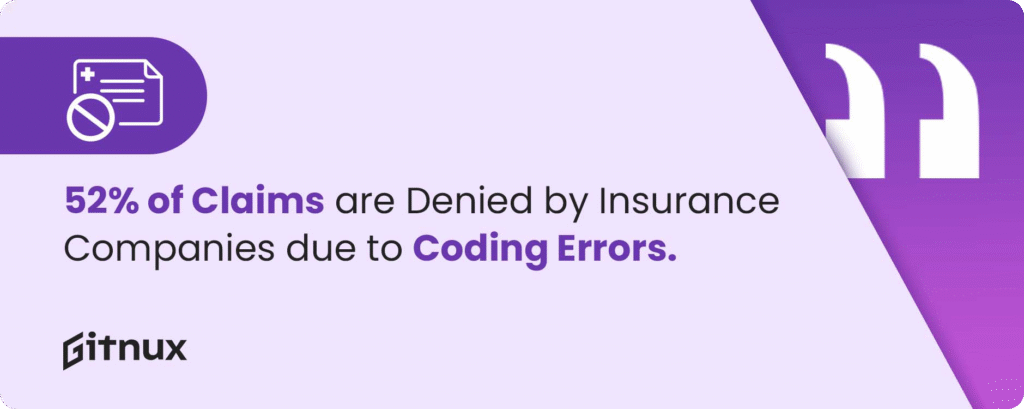
To prevent that, let’s review some common pitfalls in dental coding, with corrective actions.
Using the Wrong CDT Code
Selecting a code from the wrong category or using a similar code is a frequent mistake. It usually happens due to a lack of familiarity with the CDT manual or confusion with similar codes.
Suppose a dentist has actually placed D2790 (crown for full cast high noble metal), but you’ve coded D2740 (crown for porcelain/ceramic). Both are crown codes, but for different materials. This makes the coding wrong and leads to claim rejection.
Solution: Regularly review CDT descriptors, consult the official ADA manual, and verify that each code matches the procedure exactly.
Using Outdated or Retired Codes
Submitting claims with codes that have been retired or replaced in the latest CDT version is a common error. It often occurs when practices fail to update code manuals annually. The impact is claim rejection or processing delays due to version mismatches.
For example, submitting D9248 (non-IV sedation), when it has been replaced by new anesthesia codes in the 2026 CDT update, could trigger a denial.
Solution: Always maintain the most current CDT manual and cross-check any code before submission.
Upcoding
Upcoding occurs when a dental procedure is billed as more complex or expensive than what was performed. This can be intentional or accidental and usually results from wrongly classifying or interpreting descriptors. Impact can be huge, leading to financial, legal, and reputational risks that include claim rejections, external audits, and potential repayment requests.
For instance, coding a D2335 (two-surface composite) as D2392 (three-surface) inaccurately increases reimbursement, but makes your practice prone to legal audits. Similarly, if you bill D4341 (full quadrant scaling) when only a few teeth are treated, the insurance may pay initially, but then issue a repayment request for the difference.
Solution: Ensure procedures are coded accurately based on documentation and never select codes solely for higher reimbursement.
Undercoding
Undercoding happens when a lower-reimbursement code is submitted. Fear of rejection or lack of documentation often causes this. The impact is lost revenue and incomplete compensation for services rendered.
For example, recording a D2150 (amalgam for two surfaces) as D2140 (one surface) reduces your actual payment, leading to a massive revenue loss for your dental practice.
Solution: Maintain detailed documentation and code precisely for the actual procedure performed.
Unbundling
Billing each component of a comprehensive procedure separately, even though one CDT code includes them, is a common error. It usually arises due to not knowing the bundling rules. Consequences include claim denials or reduced payment.
For example, billing D6980 (suture removal) separately from D4210 (periodontal surgery) is considered unbundling, while the latter code includes suture removal.
Solution: Review code definitions carefully, understand included components, and bill only the comprehensive code.
Incomplete Documentation
Missing details such as tooth numbers, surfaces, or descriptors often result from rushed record-keeping. This leads to claim delays, denials, or audits.
For example, coding a crown replacement without specifying the tooth number and surface can trigger rejection.
Solution: Ensure complete clinical documentation, including tooth number, surfaces, quadrant, materials, and any supporting radiographs or photos to justify your details.
Mixing Restorative vs. Interim Restoration Codes
Specialty mistakes often occur when outdated interim restoration codes are used instead of current restorative codes. The ADA annually makes updates to the CDT code list, merging older codes into updated ones. Due to that, using an obsolete code can result in denied claims.
Suppose a dentist used D2940 (sedative/resin-based temporary restoration) for a procedure that, in the 2026 CDT update, is now captured under D2990 (resin-based restorative procedure, by report). Because D2940 is now outdated/merged, submitting it could trigger a claim denial.
Solution: Verify the latest CDT version and confirm that the code aligns with the current procedure definitions.
Missing Location Details (Tooth, Surface, Arch)
Failing to specify tooth number, surface, or arch is frequent in prosthodontics, implants, or oral surgery. ADA guidelines stress accurate location reporting for the:
- Area of the oral cavity:
- Entire area
- Arch
- Quadrant
- Tooth anatomy:
- Tooth number
- Range number
- Surface
Details must not be missed and entered accurately. Missing them or entering them incorrectly leads to claim denials or audits.
Now, let’s understand this with an example. Suppose a dentist places a crown on tooth #30 and submits the claim with D2790 (crown – full cast high noble metal), but omits the tooth number and surface. Because the payer cannot verify the treated tooth number, the claim may be denied or delayed, even though the procedure itself is medically necessary.
Solution: Always include precise tooth numbers, surfaces, and arches when coding these procedures.
Using Generic or “Unspecified” Codes
Submitting an unspecified code when a more specific code exists can lead the payer to deny your claim request and even conduct audits. Billers often do so to avoid choosing incorrectly, but it may delay reimbursement.
For example, using D1999 (unspecified preventive) instead of an available code for adult prophylaxis (D1110) may lead to payers demanding an explanation.
Solution: Use specific codes for a procedure if available; reserve “unspecified” codes for truly unique procedures with detailed narratives and no exact matches in the CDT code list.
Neglecting Annual Code Updates
Failing to update CDT codes in your database annually may result in missed coverage for newer procedures effective in 2026, like D0426 (saliva testing) or D0461 (testing for cracked tooth). This can lead to missed revenue opportunities and claim denials if you don’t use appropriate codes for procedures according to the latest updates.
Solution: Review CDT updates yearly and integrate new codes into billing practices immediately after these updates are released by the ADA.
Specialty Dental Coding: Detailed Breakdown
Dentistry spans multiple specialties, due to which you need to bill each procedure according to the category. Each of these categories has unique codes, which you must follow properly to accurately code procedures.
Diagnostic Coding
Diagnostic coding category includes all the CDT codes that cover examinations and evaluations performed to identify a dental condition.
Diagnostic codes are in the D0100–D0999 series.
Some major examples of diagnostic CDT codes include:
| CDT Code | Procedure | Description |
|---|---|---|
| D0120 | Periodic oral evaluation | A routine check-up for established patients to assess oral health and detect new problems. |
| D0140 | Limited, problem-focused exam | An exam for a specific issue like pain, swelling, or a broken tooth. |
| D0145 | Oral evaluation for a patient under 3 years | An infant/toddler exam, including caregiver education and early-childhood caries assessment. |
| D0150 | Comprehensive oral evaluation | A full and detailed exam for new patients or long-absent patients, covering complete oral conditions. |
| D0160 | Detailed and extensive problem-focused exam | In-depth evaluation for complex issues such as multiple symptoms or difficult diagnoses. |
| D0170 | Re-evaluation, limited, problem-focused | Follow-up exam to check progress, healing, or unresolved problems. |
| D0171 | Re-evaluation for post-operative visit | A post-surgery check to assess healing and ensure no complications. |
| D0180 | Comprehensive periodontal evaluation | A full exam focusing on gum and bone health, often for patients with periodontitis. |
| D0190 | Screening of a patient | A brief assessment to identify whether further evaluation is needed. |
| D0191 | Assessment of a patient | An intermediate assessment used when limited information is needed before treatment planning. |
Using clinical notes to specify findings (e.g., caries severity, periodontal status) justifies your procedure selection.
Preventive Coding
Preventive coding reports dental services that stop disease before it starts, such as cleanings, sealants, and fluoride treatments. These codes often require clear documentation of age, tooth number, and surfaces treated.
Preventive CDT codes are in the D1000-D1999 series.
Some common preventive codes are:
| CDT Code | Procedure | Description |
|---|---|---|
| D1110 | Adult prophylaxis | Routine cleaning to remove plaque, calculus, and stains in adults. |
| D1120 | Child prophylaxis | Preventive cleaning for children. |
| D1206 | Fluoride varnish | A fluoride coating applied to strengthen enamel. |
| D1208 | Topical fluoride (excluding varnish) | Fluoride application to reduce caries risk. |
| D1351 | Sealant (per tooth) | Protective coating placed on pits and fissures to prevent decay. |
| D1352 | Preventive resin restoration | Minimally invasive sealant/restoration for early lesions. |
| D1330 | Oral hygiene instruction | Patient education on proper brushing and flossing. |
| D1310 | Nutritional counseling | Counseling on diet to prevent oral disease. |
| D1320 | Tobacco counseling | Guidance to reduce disease risk from tobacco use. |
In some instances, you may need to use multiple codes. For example, for a 7-year-old receiving fluoride and sealant on molars, both D1120 and D1351 should be applied with accurate tooth numbers.
Restorative Coding
Restorative coding reports procedures that repair tooth structure damaged by decay, fracture, or wear.
These codes are in the D2000-D2999 series.
Common restorative CDT codes are:
| CDT Code | Procedure | Description |
|---|---|---|
| D2140 | Amalgam – 1 surface | Silver filling repairing one surface. |
| D2150 | Amalgam – 2 surfaces | Silver filling repairing two surfaces. |
| D2330 | Resin composite – 1 anterior | Tooth-colored filling on front tooth, one surface. |
| D2331 | Resin composite – 2 anterior | Tooth-colored filling on two surfaces of an anterior tooth. |
| D2391 | Resin composite – 1 posterior | Tooth-colored filling on the posterior tooth, one surface. |
| D2392 | Resin composite – 2 posterior | Filling and repairing two surfaces of a back tooth. |
| D2510 | Inlay metallic – 1 surface | Laboratory-made metal inlay restoring one surface. |
| D2750 | Porcelain/ceramic crown | Full-coverage ceramic crown. |
| D2920 | Re-cement or re-bond crown | Fixing a crown that has come loose. |
| D2950 | Core buildup, including any pins | Rebuilds a tooth’s core structure, including pins, to support a future crown or restoration. |
Follow these considerations while coding for restorative services:
- Use correct surfaces (mesial, distal, occlusal) to avoid denials.
- Do not bill base or liner separately if included in the restoration code.
Endodontic Coding
Endodontic coding captures procedures related to pulp therapy, root canal treatment, and other procedures involving the dental pulp and root structures.
These codes are in the D3000-D3999 series.
Common endodontic codes include:
| CDT Code | Evaluation | Description |
|---|---|---|
| D3310 | Root canal – anterior tooth | Complete endodontic therapy for a single-rooted anterior tooth. |
| D3320 | Root canal – bicuspid | Complete endodontic therapy for a single-rooted bicuspid tooth. |
| D3330 | Root canal – molar | Complete endodontic therapy for a multi-rooted molar tooth. |
| D3346 | Retreatment – anterior | Retreatment of the previous root canal on a single-rooted anterior tooth. |
| D3347 | Retreatment – bicuspid | Retreatment of the previous root canal on a single-rooted bicuspid tooth. |
| D3348 | Retreatment – molar | Retreatment of the previous root canal on a multi-rooted molar tooth. |
| D3351 | Apexification/recalcification – initial visit | Induction of root-end closure in immature teeth with necrotic pulp. |
| D3352 | Apexification/recalcification – follow-up | Subsequent visit for completion of root-end closure therapy. |
| D3410 | Apicoectomy – anterior | Surgical removal of the root tip of an anterior tooth. |
| D3421 | Apicoectomy – bicuspid | Surgical removal of the root tip of a bicuspid tooth. |
While coding for endodontic procedures, make sure to:
- Always select the code that matches the tooth type and number of roots (anterior, bicuspid, molar) to avoid over- or undercoding.
- Document all pulp therapy procedures, retreatments, and apexification visits clearly, including tooth number and any complications, to support accurate billing and reduce denials.
Periodontal Coding
Periodontal coding reports the diagnosis and treatment of gum disease, bone loss, and supporting structures of the teeth.
These codes are in the D4000-D4999 series.
Common codes include:
| CDT Code | Procedure | Description |
|---|---|---|
| D4341 | Scaling and root planing (4+ teeth/quadrant) | Deep cleaning to remove subgingival deposits. |
| D4342 | SRP (1-3 teeth/quadrant) | Deep cleaning localized to fewer teeth. |
| D4910 | Periodontal maintenance | Ongoing gum disease maintenance cleaning. |
| D4355 | Full-mouth debridement | Initial gross cleaning to allow proper evaluation. |
| D4381 | Local antimicrobial placement | Medication placed into diseased periodontal pockets. |
| D4210 | Gingivectomy-4+ teeth | Removal of diseased gum tissue. |
| D4260 | Osseous surgery-4+ teeth | Surgical correction of bone defects around teeth. |
| D4911 | Adjunctive periodontal home plan | Home-care periodontal program prescribed. |
While coding periodontal procedures:
- Include pocket depths, periodontal charting, and radiographs to support scaling or surgical procedures.
- Specify quadrant or full-mouth treatment as required by the CDT descriptor.
Prosthodontic Coding
Prosthodontic coding is used for coding dentures, bridges, implants, and other tooth-replacement procedures. In fact, some complex procedures in prosthodontics require dedicated coding expertise and workflows, such as dentures and implants coding.
Prosthodontic codes are categorized in the D5000-D6999 series. This category is divided into three main sub-categories.
These include:
- Removable prosthodontics
- Maxillofacial prosthetics
- Implants
- Fixed prosthodontics
Let’s explore the purpose of all these subcategories with the most frequent codes in each category.
Removable Prosthodontics
This category captures dental procedures for creating and maintaining removable dental prostheses, including complete and partial dentures, and resection prostheses. Series are D5000-D5899.
Common codes are:
| CDT Code | Procedure | Description |
|---|---|---|
| D5000 | Complete denture – maxillary | Fabrication of a full upper denture. |
| D5010 | Complete denture – mandibular | Fabrication of a full lower denture. |
| D5020 | Immediate denture – maxillary | Denture placed immediately after extraction. |
| D5030 | Immediate denture – mandibular | Denture placed immediately after extraction. |
| D5110 | Partial denture – maxillary | Removable partial denture for the upper arch. |
| D5120 | Partial denture – mandibular | Removable partial denture for the lower arch. |
| D5730 | Reline – chairside | Chairside relining of existing removable prosthesis. |
| D5740 | Reline – laboratory | Lab-processed relining of existing removable prosthesis. |
| D5750 | Rebase – laboratory | Complete replacement of the denture base while retaining teeth. |
| D5875 | Tissue conditioning | Application of a temporary soft liner to improve tissue adaptation. |
Maxillofacial Prosthetics
Maxillofacial prosthetics covers specialized dental prostheses that restore or replace facial and oral structures lost due to trauma, surgery, congenital defects, or disease.
These procedures are billed in the D5900-D5999 series. Common procedures include:
| CDT Code | Procedure | Description |
|---|---|---|
| D5900 | Maxillofacial prosthesis – surgical obturator | Prosthesis placed immediately after maxillectomy to aid healing and function. |
| D5901 | Maxillofacial prosthesis – interim obturator | Temporary prosthesis for patient adaptation before the final prosthesis. |
| D5902 | Maxillofacial prosthesis – definitive obturator | Final prosthesis for maxillary defect rehabilitation. |
| D5910 | Facial prosthesis – nasal | Prosthesis to restore the nose following trauma or surgery. |
| D5911 | Facial prosthesis – auricular (ear) | Prosthesis to restore ear anatomy. |
| D5912 | Facial prosthesis – orbital | Prosthesis to restore the eye/orbital area post-surgery or trauma. |
| D5913 | Facial prosthesis – combination | Prosthesis covering multiple facial structures. |
| D5920 | Mandibular resection prosthesis – complete | Removable prosthesis for mandibular resection cases. |
| D5930 | Mandibular resection prosthesis – partial | Partial removable prosthesis for mandibular defects. |
| D5938 | Maxillary resection prosthesis – partial | Partial removable prosthesis for maxillary defects. |
Implants
Implant codes capture placement, maintenance, and removal of dental implants, as well as implant-supported prostheses.
These procedures are covered in the D6000-D6199 series. Common codes are:
| CDT Code | Evaluation | Description |
|---|---|---|
| D6010 | Surgical placement – endosteal implant | Placement of a single implant into the bone. |
| D6011 | Surgical placement – additional implant | Placement of an additional implant in the same arch. |
| D6012 | Surgical placement – interim implant | Temporary implant placement. |
| D6013 | Surgical placement – immediate implant | Implant placed immediately after extraction. |
| D6020 | Surgical placement – staged implant | Implant placed in a staged surgical approach. |
| D6030 | Surgical placement – mini implant | Placement of a narrow-diameter implant. |
| D6040 | Surgical placement – implant-supported denture | Implant placement for supporting a denture. |
| D6056 | Prefabricated abutment | Attachment placed on an implant to support a prosthesis. |
| D6065 | Implant-supported crown – porcelain fused to metal | Crown placed on abutment attached to the implant. |
| D6196 | Removal of indirect restoration on implant | Removal of a crown or bridge from an implant abutment. |
Fixed Prosthodontics
Fixed prosthodontics codes cover permanent restorations such as crowns, bridges, and related procedures that are cemented or bonded in place. These are billed in the D6200-D6999 series.
Common fixed prosthodontics codes include:
| CDT Code | Evaluation | Description |
|---|---|---|
| D6210 | Pontic – cast high noble metal | Replacement tooth in a fixed bridge, high noble metal. |
| D6211 | Pontic – cast predominantly base metal | Replacement tooth in a fixed bridge, base metal. |
| D6212 | Pontic – cast noble metal | Replacement tooth in a fixed bridge, noble metal. |
| D6240 | Pontic – porcelain fused to high noble metal | Esthetic fixed bridge replacement tooth. |
| D6250 | Pontic – porcelain fused to predominantly base metal | Esthetic fixed bridge replacement tooth. |
| D6545 | Retainer crown – porcelain fused to high noble metal | Crown used to support a bridge. |
| D6750 | Crown – porcelain fused to high noble metal | Full crown with PFM material. |
| D6790 | Crown – full cast noble metal | Full crown made entirely of noble metal. |
| D6242 | Pontic – resin with high noble metal | Fixed bridge pontic with resin and metal framework. |
Oral Surgery Coding
Oral surgery coding covers all the oral surgery procedures, such as surgical extractions, incisions, bone procedures, and treatment of pathological oral conditions.
These procedures are billed in the D7000–D7999 series.
Common oral surgery codes include:
| CDT Code | Procedure | Description |
|---|---|---|
| D7140 | Simple extraction | Removal of an erupted tooth requiring minimal effort. |
| D7210 | Surgical extraction | Removal requiring bone removal and/or sectioning. |
| D7220 | Impacted tooth removal-soft tissue | Removal of a partially impacted tooth under soft tissue. |
| D7230 | Impacted tooth-partial bony | Removal requiring partial bone removal. |
| D7240 | Impacted tooth-complete bony | Removal requiring extensive bone removal. |
| D7250 | Surgical removal of residual root | Removal of root pieces remaining in the bone. |
| D7510 | Incision/drain abscess-soft tissue | Surgical release of the infected area. |
| D7520 | Incision/drain abscess-bone | Drainage of the abscess within the bone. |
| D7680 | Surgical splint fixation | Stabilization of the injured jaw or teeth. |
| D7901 | Bone graft for ridge preservation | Grafting bone to preserve the extraction site. |
While billing oral surgery procedures:
- Document tooth numbers, surgical site, anesthesia type, and complexity of the extraction or procedure.
- Include any adjunctive procedures like suture removal only if the payer allows separate billing.
Orthodontic Coding
Orthodontic coding reports diagnostics and treatments used to align teeth and correct bite issues in children and adults.
These are billed in the D8000-D8999 series.
Orthodontic coding examples include:
| CDT Code | Procedure | Description |
|---|---|---|
| D8070 | Limited ortho-child | Minor orthodontic treatment for children. |
| D8080 | Comprehensive ortho-child | Full braces treatment for children. |
| D8090 | Comprehensive ortho-adult | Full braces treatment for adults. |
| D8660 | Pre-orthodontic exam | Evaluation for orthodontic treatment need. |
| D8670 | Periodic orthodontic visit | Ongoing braces adjustment visit. |
| D8680 | Retention appliance | Retainer for maintaining alignment. |
| D8691 | Repair orthodontic appliance | Fixing a broken brace component. |
| D8692 | Replacement of ortho appliance | Replacing a damaged orthodontic appliance. |
| D8703 | Temporary anchorage device (TAD) | A small screw used to assist orthodontic movement. |
| D8710 | Ortho retainer replacement | New retainer after loss or damage. |
In orthodontics, follow these key recommendations for precise coding:
- Document treatment type (comprehensive, limited, interceptive) and appliance used.
- Note start and end dates, tooth movement, and any adjunctive procedures.
Adjunctive General Services
Adjunctive General Services include procedures that support or complement primary dental treatments, such as palliative care, sedation, occlusal therapy, photobiomodulation, and other miscellaneous services.
These codes, billed under the D9000-D9999 series, are often used to document supportive care or procedures not covered under standard categories.
Common codes of adjunctive general services are:
| CDT Code | Procedure | Meaning |
|---|---|---|
| D9110 | Palliative (emergency) treatment | Minor procedure to relieve dental pain temporarily without definitive treatment. |
| D9120 | Deep sedation/general anesthesia – first 30 min | Administration of anesthesia to facilitate dental procedures for patients requiring sedation. |
| D9222 | Deep sedation/general anesthesia – first 30 min | Initial 30-minute period of deep sedation or general anesthesia. |
| D9223 | Deep sedation/general anesthesia – each additional 15 min | Time beyond the first 30 minutes of sedation/anesthesia. |
| D9219 | Evaluation for moderate sedation | Assessment of patient suitability for moderate sedation. |
| D9128 | Photobiomodulation therapy – first 15 min | Light-based therapy for pain relief or tissue healing. |
| D9129 | Photobiomodulation therapy – each subsequent 15 min | Additional time for ongoing photobiomodulation therapy. |
| D9450 | Emergency treatment of dental trauma | Immediate intervention for dental injury. |
| D9970 | Occlusal guard – hard appliance, full arch | Fabrication or delivery of an occlusal appliance to protect teeth. |
| D9972 | External bleaching – per arch | Cosmetic whitening procedure for one dental arch. |
While entering codes for adjunctive general services:
- Document procedure type, duration, patient condition, and monitoring for each procedure.
- Include consent forms and clinical notes, especially for sedation, anesthesia, or emergency treatments, to support medical necessity and payer compliance.
Pediatric Dentistry Coding
Pediatric coding reports diagnostic, restorative, and preventive services designed specifically for infants and children. These procedures overlap with all the above categories in dentistry.
Common pediatric codes are:
| CDT Code | Procedure | Meaning |
|---|---|---|
| D0145 | Infant oral evaluation | Exam for early childhood dental issues. |
| D1120 | Child prophy | Cleaning for children. |
| D1355 | Caries preventive medicament | Brush-on preventive material for kids. |
| D2391 | Posterior composite – 1 surface | Tooth-colored filling for children’s molars. |
| D2921 | Pulpotomy | Removal of coronal pulp tissue. |
| D2930 | Prefabricated crown—primary | Stainless steel crown for baby teeth. |
| D2934 | Prefabricated esthetic crown | Tooth-colored pediatric crown. |
| D3220 | Therapeutic pulpotomy | Vital pulp therapy for kids. |
| D1510 | Space maintainer – fixed | A device to hold space after early tooth loss. |
| D1551 | Space maintainer repair | Fixing or adjusting a maintainer. |
Key recommendations for coding pediatric dentistry procedures are:
- Recording age-appropriate preventive and restorative procedures, including sealants and pulp therapy.
- Specifying tooth type and surfaces for pediatric restorations and extractions.
General Dentistry Coding
General dentistry coding reports routine examinations, radiographs, diagnostics, and emergency treatments used across all patient types. These usually overlap with other categories of dental coding.
Some examples include:
| CDT Code | Evaluation / Procedure | Meaning |
|---|---|---|
| D0120 | Periodic exam | Routine evaluation of oral health. |
| D0150 | Comprehensive exam | Full assessment for new or returning patients. |
| D0274 | Bitewing x-rays – 4 films | Detects decay and bone levels. |
| D0330 | Panoramic x-ray | Full-mouth radiographic scan. |
| D0460 | Pulp vitality testing | Checking if a tooth is alive. |
| D0461 | Cracked tooth test | Diagnostic test for fracture lines. |
| D0999 | Unspecified diagnostic | Miscellaneous evaluation service. |
| D9110 | Palliative treatment | Emergency pain relief. |
| D9440 | Office visit – after hours | Visit outside normal hours. |
| D9997 | Behavior management | Techniques for managing anxious patients. |
Rules and Regulations for Dental Coding
Let’s have a quick revision of the essential rules and regulations for dental coding, which we’ve discussed above, so your staff can find them all in one place.
- Annual CDT Updates: Follow ADA’s CDT updates every year to ensure correct and current code usage.
- Regulatory Compliance: Adhere to HIPAA, payer policies, Medicaid, and Medicare guidelines when coding and submitting claims.
- Thorough Documentation: Record every service, procedure date, tooth numbers, surfaces, and materials used for accurate claims.
- Pre-Authorization Required: Obtain prior authorizations when required, especially for prosthodontics, implants, orthodontics, and sedation procedures.
- CDT Standardization: Use ADA CDT codes to standardize procedure reporting. These codes describe a procedure that’s been performed, not what’s covered in a plan.
- Use of Modifiers: Apply CDT-approved modifiers only when procedures involve exceptions, multiple surfaces, or unusual circumstances.
- Diagnostic Pairing: Pair CDT codes with ICD-10-CM diagnoses when needed, especially for medically-linked procedures.
- Bundling Rules: Avoid unbundling. Do not bill separately for components already included in a comprehensive code.
- Ethical Coding: Select codes based on procedures performed. Don’t try to use other codes that may offer higher reimbursements, and avoid upcoding or undercoding.
- Audits and Verification: Maintain accurate records for audits. Periodic review helps prevent compliance issues and denials.
Best Practices for Efficient Dental Coding
Conduct Staff Training
Train your team regularly and educate them about the latest coding changes by the ADA. Since these codes are annually updated, it’s crucial to know these codes.
Equip your staff with ADA resources like coding manuals, guides, and webinars, making it easier for them to adopt new codes and subsequently prevent claim denials.
For example, ADA has added a new code D5940 for fabricating a removable partial prosthesis (a denture or similar appliance) for the maxillary (upper) arch in its latest 2026 update. Previously, these services were covered in codes like D5211 or D5213, but now it has a new code, which must be used in 2026.
Perform Frequent Audits
Performing dental billing audits helps you evaluate previously billed claims, so you catch errors and prevent future mistakes.
For instance, reviewing past claims may reveal repeated misselection of D1110 versus D1120. Both these codes are used for prophylaxis, but D1110 is used for adults, while D1120 is used for children.
Use Procedure Cheat-Sheets
Create quick-reference sheets for commonly performed procedures. For example, while coding, your staff can quickly reference that the CDT D0220 is an intraoral periapical radiograph. As a result, they can enter the proper code on the spot, thus reducing mistakes and speeding up claim submissions during busy patient visits.
Pre-Authorization for Expensive Procedures
Obtain prior authorization from insurance companies for costly treatments such as implants, orthodontics, or sedation. For instance, a D6010 implant may require approval from Delta Dental before placement to ensure coverage and prevent denied claims.
EHR Integration with CDT
Implement your electronic health record (EHR) systems with built-in CDT code selection. These systems reduce manual errors and automatically link codes to documentation and billing, improving accuracy and efficiency.
Outsource Dental Billing and Coding
Since dental coding has a huge impact on the accuracy of claim submissions and subsequent reimbursements, it’s crucial to ensure that procedures are coded precisely.
A major way to do so is to outsource your billing and coding services to a reliable organization like TransDental. These billing companies employ trained dental billers and coders. Whether it’s mastering dental billing terminology or adapting to latest ADA updates and requirements, these experts enhance their knowledge and put it into action efficiently. These billers are also well-aware of the policies of each payer and state, allowing your coding workflows to stay compliant.
Moreover, outsourcing billing and coding reduces workload for your staff, minimizes human errors, and automates processes to ensure time-consuming tasks are completed in seconds.
Future of Dental Coding and Automation in 2026 and Beyond
CDT Code Evolution and Digital Dentistry
The ADA’s CDT 2026 reflects advances in digital workflows and dental technology. New codes, like D0802 (3D dental surface scan – indirect) and D2991 (hydroxyapatite regeneration medicament), standardize documentation for procedures involving 3D printing, digital scans, and regenerative materials.
For example, in the future, D0802 can be used to document a lab-fabricated digital crown for the scan, ensuring accurate claims submission. These updates allow your practice to leverage the latest technology for efficiency in diagnosis and treatments, while ensuring maximum reimbursements.
Artificial Intelligence and Predictive Analysis in Coding
AI is increasingly applied to automate CDT code selection, audit claims, and flag errors before submission. Tools analyze X-rays for caries detection, assess documentation completeness, and suggest codes based on clinical findings.
Moreover, predictive analytics flag inconsistencies, mismatched tooth numbers, or missing surfaces, helping prevent denials and speeding up reimbursement.
For example, an AI-assisted software can detect a molar lesion on a radiograph and recommend D2392 (resin-based composite, two surfaces, posterior), reducing human coding errors and preventing undercoding. Predictive analytics further identifies claims likely to be denied, improving workflow efficiency.
Teledentistry Coding and Policy Standardization
Standardized codes like D9995 (synchronous) and D9996 (asynchronous) are now widely used for teleconsultations. Place of Service (POS) codes, such as 02 or 10, ensure proper reimbursement and compliance.
ADA policy allows teledentistry visits to be reimbursed, just like in-practice care, when the standard of care is met.
For example, a virtual consultation for postoperative implant check can be billed with D9995 + D6010 (implant placement follow-up) and POS code 10 for home telehealth, and sent for claim submission.
Medical-Dental Integration and Cross-Coding
Dentists increasingly submit claims to medical insurers using CPT and ICD-10-CM codes for systemic conditions like TMJ disorders or sleep apnea. Preventive procedures for high-risk patients, such as D1354 (silver diamine fluoride) or D1352 (preventive resin restoration), are linked to medical necessity to maximize reimbursement.
For example, a patient with high caries risk and a history of systemic disease may receive D1354 while the claim includes ICD-10-CM K02.53 (dental caries on pit and fissure surfaces, recurrent), ensuring coverage under medical insurance.
Resources, Cheat-Sheets, and Downloadable References
The table below describes some useful materials your billing teams and other departments need to stay current with CDT coding trends and usage requirements in 2026.
| Resource | Type | Description / Use | Link |
|---|---|---|---|
| ADA CDT 2026 Manual | Official CDT Code Book | Complete CDT code set with nomenclature, descriptors, and updates for 2026; primary reference for all dental coding. | ADA CDT Store |
| CDT 2026 Companion Guide (Digital) | Guide / PDF | Provides detailed explanations, examples, and coding tips for each CDT category, making it useful for staff training. | ADA CDT Companion |
| CDT 2026 Quick Reference / Cheat-Sheet | Quick Reference | One-page or tabular summary of commonly used codes, organized by category, to simplify daily coding. | Often included with manual purchase or downloadable via the ADA membership portal |
| CDT Code Lookup Tool | Online Tool | Web-based search tool for codes, descriptors, and current status; helps verify correct CDT codes quickly. | ADA CDT Search |
| State Medicaid CDT Guides | Policy Reference | Provides payer-specific coding rules, modifiers, and examples for Medicaid-covered dental procedures. | Check your state’s Medicaid website (e.g., Hawaii Med-QUEST CDT Guide for Hawaii) |
| CDT 2026 Updates / News | Newsletter / Updates | Summaries new, revised, or deleted codes annually, highlighting trends or special notes. | ADA News – CDT 2026 Updates |
| Teledentistry Coding Cheat-Sheet | Quick Reference | Focused guide for D9995 and D9996, including POS codes, documentation, and billing examples. | ADA Teledentistry Guide PDF |
Conclusion
The accuracy of your claim submission and entire dental billing process relies on the CDT codes you use while filing claims. So, make sure that you either hire experienced coders or partner with well-known companies that can handle your billing and coding very well. Nowadays, it’s important to leverage technology while staying compliant with payer and state-specific coding requirements. Following these best practices reduces claim denials and ensures faster reimbursements, driving revenue growth for your dental practice.
Frequently Asked Questions (FAQs)
What is the main purpose of dental coding?
Dental coding standardizes procedure documentation to ensure accurate billing, insurance claims, and patient record-keeping.
How do CDT codes differ from ICD-10 codes?
CDT codes describe dental procedures, whereas ICD-10 codes indicate diagnoses or conditions treated. These are often used together for insurance justification.
What are the most common CDT codes used in general dentistry?
Some of the most common CDT codes are D0120 (periodic evaluation), D1110 (adult prophylaxis), D1206/D1208 (fluoride application), D2330 (restorative filling), and D2751 (crown).
What are common mistakes in dental coding?
Using outdated codes, incorrect category selection, unbundling, undercoding/overcoding, incomplete documentation, and ignoring annual CDT updates are some of the common mistakes in dental coding you must avoid. You can do so by reviewing your codes and claim submissions frequently.
How often are dental codes updated in the US?
CDT codes are updated annually by the ADA. Practices must reference the version effective on the service date.
Do I need to use ICD-10 with CDT for all procedures?
ICD-10 is required when insurance or payer rules mandate diagnosis documentation alongside the CDT procedure code, particularly for medical coverage overlap.