When you’re busy treating patients, but not getting paid right, it’s a huge issue. You might wonder if it’s due to time constraints spent in managing lengthy patient flows (patients’ complete stay at the practice). But the issue is something else. And that’s missing patient scheduling accuracy. Small gaps in booking, uneven appointment lengths, and last-minute cancellations can reduce your daily production.
It’s important to know that patient scheduling is a key step in dental RCM. The process must be correct, or you can risk revenue loss. When practices don’t plan schedules correctly, they delay high-value procedures, waste staff time, and make the whole process full of errors, affecting collections.
This is where scheduling accuracy is important in managing your revenue cycle.
Ready to know how? In this guide, we’ll look at how scheduling accuracy impacts revenue, where practices lose money, the key performance indicators to identify the scheduling issues causing revenue loss, and how to use professional front office management services for accuracy.
What is Scheduling Accuracy in Dental Revenue Cycle?
Before figuring out the relationship between accurate scheduling and dental revenue outcomes, let’s learn about these key terms.
Patient Scheduling in Dental Billing
Patient scheduling in dental billing is the strategic process of booking, confirming, and managing patient appointments to maximize production while minimizing gaps. It serves as the base of the dental revenue cycle. This step helps make sure that RCM steps, such as insurance verification, treatment planning, and pre-authorizations (if required), are accurate before the patient receives the treatment at the practice. When patient scheduling is right, it makes your complete RCM smooth, reduces claim denials, and ensures timely payments.
Definition of Scheduling Accuracy
Simply put, scheduling accuracy is the process of allocating the correct time, provider, and resources to each patient’s appointment. The purpose is to align clinical capacity with patient demand and minimize idle chair time and scheduling gaps that cause significant loss in revenue.
How Are Scheduling and RCM Linked?
Scheduling and RCM are tightly connected. Scheduling patient appointments without verifying their coverage and benefits can cause claim denials in the later stages of dental RCM. When the front-end staff fails to confirm copays, deductibles, or coordination of benefits, patients may face unexpected bills. It makes patient balance management harder.
Plus, if you accidentally book two patients in the same slot or see a gap in the schedule, it’s time to check the errors and correct them. Double booking can lead to a negative patient experience, and your practice can risk reputational harm.
Why Does Scheduling Accuracy Matter for Revenue?
Being the foundational step in the front-end revenue cycle processes, patient scheduling plays a key role in securing claim reimbursements. Scheduling accuracy:
- Improves patient flow and reduces wait times
- Increases collections and case acceptance
- Maximizes daily production
- Prevents overbooking and underbooking
How Does Scheduling Accuracy Improve Revenue Outcomes?
Now, since you know what scheduling accuracy is and how it can impact the revenue outcome, let’s take a step ahead and learn about how accurate patient scheduling can improve the practice revenue.
Better Time Allocation for High-Value Procedures
Scheduling determines who visits your practice to receive dental services and which treatments patients receive. During patient scheduling, the staff confirms the patients’ initial symptoms, along with their dental and/or medical records. This data helps prepare a complete treatment plan, which includes the dental procedure.
With that, the front desk staff can control the patient enrollment. They can:
- Block scheduling for complex treatments, as there are high risks of claim denials, owing to the difficult pre-authorization processes in such cases.
- Prioritize high-revenue services such as the treatments associated with endodontics and periodontics, which are often highly rewarding.
- Reduces scheduling conflicts by allocating different time slots for different patients.
Improved Patient Experience and Retention
Scheduling accuracy reduces waiting time for patients and provides better time slots for appointments. It improves their satisfaction and loyalty, resulting in positive word-of-mouth for your practice. With that, you’re likely to retain patients and increase patient volume as well.
Reduced Staff Workload
Proper scheduling balances workload for your practice staff. Last-minute schedule changes are very few, and it’s easy to manage a timetable. As a result, there are fewer chances of errors in claim submission, while higher reimbursements are more likely.
Accurate Patient Eligibility and Benefits Verification
All steps in dental RCM are directly linked. When you schedule appointments without any errors, you can correctly verify patients’ eligibility and available benefits in the coverage. Correct verification mostly leads to a clean claim submission.
If the front-end staff collects the right details of the patient, provider, and payer during scheduling, eligibility verification becomes easier and more accurate, leaving little room for claim denials.
Reduced Cancellations and No-Shows
No-shows and appointment cancellations are common issues in dentistry. They cost the practices a lot of money. When scheduling is correct and patients are notified about their appointments, there are fewer chances of no-shows and cancellations. So, scheduling accuracy reduces unwanted cancellations.
Optimized Resource Utilization
Accurate patient scheduling acts as a critical lever for optimizing resource utilization, a metric used to calculate how properly a practice allocates and utilizes its staff in their working hours.
A better resource utilization means that you’re using them correctly. The purpose is to make sure that staff, equipment, and operating rooms are available for patients when required.
The best way to check resource utilization is to divide staff members’ productive hours (the time staff have worked) by the total available hours (total time they’re present in the practice) and multiply it by 100. You get the resource utilization percentage.

Let’s make it simple with this example.
Suppose your practice employs 8 staff members and each staff member is required to perform their duties for 8 hours a day. Their cumulative available hours are 320. However, they cumulatively work for 300 hours a day.
Divide 300 productive hours by 320 available hours and then multiply it by 100. Your resource utilization is 93.75%, which is impressive.

By leveraging data-driven techniques, digital tools, and predictive analytics, dental practices can significantly reduce operational bottlenecks, improve staff productivity, and maximize patient volume.
How to Measure Scheduling Accuracy: Key Performance Indicators (KPIs)
The key performance indicators, which depend on scheduling accuracy, help measure a practice’s revenue performance and outcome in the following ways:
Appointment Utilization Rate
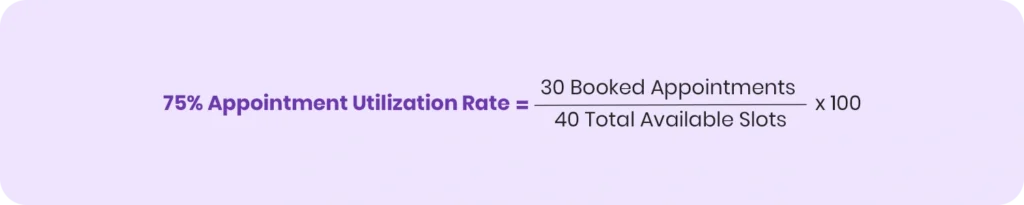
This metric is calculated by dividing the booked appointments by the total number of available slots and multiplying it by 100. In short, it calculates how many patients are showing up for treatments and visiting your practice.
Let’s simplify it with this formula:

You must achieve a higher appointment utilization rate for better performance.
Example: You’ve booked 30 appointments out of the total 40 available slots in a day. When you divide the booked appointments by the total available slots and multiply it by 100, the appointment utilization rate is 75%.
No-Show Rate
No-show rate measures how often patients miss appointments.
The following is the formula:

Note: A higher no-show rate impacts the practice revenue outcome negatively.
Example: Suppose you’ve scheduled 30 total appointments in a week. 6 patients didn’t show up for the treatment.
You divide the 6 no-shows by 30 total appointments and multiply them by 100 to get the no-show rate. The percentage is 20%.

Chair Utilization Rate
Chair utilization rate shows how efficient chair time is. In simple terms, it’s used to check the actual patient’s treatment time.
It is expressed as:

A higher chair utilization rate means that more patients are visiting you, consequently making it more profitable.
Example: If your practice has 8 hours (480 minutes) of available chair time and you use 360 minutes, you divide 360 minutes by 480 minutes and multiply it by 100. The chair utilization rate is 75%.

How Does Outsourcing Improve Scheduling Accuracy?
Outsourcing billing services to a reputable company, like TransDental, can improve scheduling accuracy. Reliable billing partners offer professional and efficient scheduling support, so you can spend more time on patient care. By shifting your administrative burden to patient care, you can optimize appointment scheduling and improve overall revenue cycle efficiency for better revenue outcomes.
Conclusion
Scheduling, being the foundation step in dental RCM, has a direct impact on overall revenue outcomes. Accurate patient enrollment ensures better revenue management by allocating better time to high-value procedures, minimizing errors in eligibility verification, and reducing cancellations and no-shows.
If your practice underperforms financially despite high patient volume, your schedule might be the hidden problem. Fixing scheduling accuracy doesn’t require more patients; rather, it requires better planning.
Frequently Asked Questions (FAQs)
How does scheduling accuracy directly impact dental practice revenue?
Scheduling accuracy ensures that appointment times match the complexity of procedures. It reduces gaps between appointments and maximizes chair utilization. When patient scheduling is accurate, it eliminates wasted time and allows the practice to see more patients. Ultimately, that drives higher daily production and profitability.
What is the cost of poor scheduling on my practice’s revenue?
Poor scheduling leads to high no-show rates and unused chair time, which can cost a practice tens of thousands of dollars annually. Each empty chair slot represents immediate lost revenue. The practice loses the opportunity to perform high-value treatments, leading to revenue loss.
How can I reduce no-shows and cancellations through scheduling?
Implementing real-time online scheduling and automated appointment reminders can significantly reduce cancellations. Patients who can book their appointments online are more likely to keep their commitments, and online scheduling allows patients to select times that fit their schedule. Thus, it decreases last-minute cancellations.
Can scheduling more than one patient at a time increase revenue?
Using a team-based approach, such as having a hygienist perform a recall appointment while the dentist performs a restorative procedure in another room, increases total daily revenue. The key is to ensure the schedule is not overbooked, which can cause delays and patient frustration.