
What is a dental claim submission? It’s the process of submitting dental claims to an insurance company for treatments provided to the dental patients. And practices know that!
But the one thing that most practices don’t know is the complete and proper process. This is where billers end up submitting wrong claims that payers deny. If you leave it, your revenue is written off, but if you rework, you may recover, but your staff needs to dedicate their precious time all over again.
Want to get rid of the revenue loss and prevent the hassle of reworking claim denials? We’ll assist you with that in this blog, guiding you through all the steps in a claim submission workflow, along with best practices for claim approvals and faster payments.
What are the Steps in a Dental Claim Submission Workflow?
Whether you rely on end-to-end dental RCM services or manage billing in-house, mastering the claim submission process is important to recover your due payments.
Here are the steps in a complete workflow:
Insurance Eligibility Verification
Dental claim submission is a step in the mid-revenue cycle process for dental billing, but the actual workflow begins with the front end, with insurance eligibility verification. This step helps check if a patient is eligible to receive a treatment under the coverage plan.
It also assists with benefits and coverage validation, helping find out the number of times a patient can receive a treatment during the calendar year and how much the dental payer covers for that treatment.
When you verify a patient’s coverage status and benefits in real-time, it helps you plan treatment accordingly and also know the patient’s responsibilities. When you know what the patient’s going to pay, you can easily explain that to the patient, preparing them for the expenses ahead, and letting them decide to proceed with it or delay the procedure.
CDT Coding
After verifying eligibility, you move to the next step, and that’s to select the CDT coding for the dental procedure. Stay updated with the American Dental Association’s coding updates and guidelines, while also following your payer’s provider manuals to check their list of billable procedure codes.
With that, you can select the right procedure code and maintain CDT coding accuracy to make your claim submission workflow smooth and error-free.
Pre-Authorization
Some dental claims aren’t complete without prior authorization from insurance companies. Payers need to check if the procedure is valid and necessary for the patient’s health. They mostly require practices to obtain approval for costly procedures like crowns, dentures, implants, and oral surgeries.
Payers don’t want to reimburse unnecessarily for treatments that can result in a revenue strain.
So, make sure to confirm with the payer if they need pre-authorization for a procedure. You may also find the list of dental procedures requiring pre-authorization in provider manuals, and you can still confirm with the payer to prevent claim denials.
When the payer confirms that they need the authorization, submit it properly by mentioning the relevant CDT code and attaching the supporting evidence, like pre-operative dental radiographs, clinical narratives, intraoral photos, and periodontal charts (for periodontal procedures).
These documents help prove if a treatment is necessary for the patient’s health and needs reimbursement.
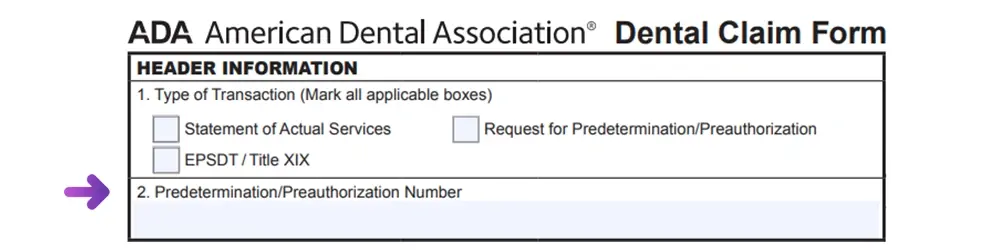
And this step must be performed before a treatment. If the payer deems it necessary, they provide you with a pre-authorization number.
Go ahead and treat the patient, and after that, when you fill out your claim form, enter the payer’s provided pre-authorization number in Field No. 2 in the ADA Dental Claim Form.
You can check that in the image below:
Documentation Requirements
Documentation may still be required even if pre-authorization isn’t needed.
The criteria are almost the same, but the difference is that pre-authorization is required before treating a patient, while some documents are required post-treatment.
Along with pre-op radiographs and other documents, you must also attach post-op radiographs and other documents as evidence that you have treated the patient.
Documents also help evaluate clinical success and strengthen your claim submission workflow. Payers need strong evidence on the patient’s condition and subsequent treatment to decide if it’s worth reimbursement.
Pro tip: Make sure your documents are up to the mark. Radiographs are diagnostic quality, periodontal charts are complete with 6-point probing requirements, and clinical narratives are concise but describe all details of the patient’s treatment.
Claim Form Filling
This is perhaps the most crucial step in a claim submission workflow, where you need to fill out the entire dental claim form. And this must be done very carefully.
The ADA dental claim form is the standard for claim submission accepted by the Centers for Medicare & Medicaid Services (CMS) and most commercial payers.
Some payers, like Aetna and Blue Cross Blue Shield, have their own separate claim forms. But most payers rely on the ADA dental claim form.
This claim form has a total of fifty-eight fields, which require you to enter:
- Patient details (name, date of birth, insurance ID, etc.)
- Policyholder name, date of birth, address, etc. (if not the patient)
- Provider details (name, NPI number, practice address, signature, etc.)
- Treatment details (CDT code, tooth number, tooth surface, description, fee, place of treatment, etc.)
Make sure all the fields are entered correctly and your claim form fills all the payer’s requirements for CDT coding, documentation, fee schedule, and other details.
Claim Scrubbing
Dental claim scrubbing is an important process that makes sure your claim is compliant with the payer’s policies and complete. There must be no wrong CDT codes, spelling mistakes, or missing documentation.
It detects billing errors and flags them, rejecting your claim in the process. It’s a proactive approach, which prevents costly claim denials and allows your billing staff to correct the claim forms. These corrections can be:
- Attaching all the missing documents
- Filling all the incomplete fields
- Correcting spelling mistakes
- Entering the right CDT codes
- Using the correct NPI number
Claim scrubbing is actually a protection for your dental claims, reducing time spent on unnecessary reworks and denial management.
Clearinghouse Transmission
After claim scrubbing and correction, the final step in claim submission is clearinghouse transmission. It converts your dental claims into the payers’ required HIPAA-compliant electronic format, also known as 837D. The clearinghouse then sends the dental claim to the insurance company, which reviews and approves it for reimbursement.
What are the Best Practices to Optimize Claim Submission Workflow?
Submit Claims Electronically
Most dental insurers prefer billers to submit claims electronically, via an all-in-one practice management system or a payer portal. PMS may also integrate with the payer portal, making the process much easier.
If you’re wondering why electronic claims are the preferred choice, it’s because these are fast to process, reach payers quickly, and reimbursements are easier. Payers send you the dental explanation of benefits, along with the payment, which you can post to the patient account to complete the payment against the procedure.
Implement Payer Policies in Your System
It’s difficult to navigate different payer policies. When you’re handling billing for multiple insurance companies, it isn’t easy to review them all and submit compliant claims. The best solution is to leverage automation in your software and implement the payer policies in your claim submission workflow.
You may integrate with your payer portal for real-time updates, or upload the payer’s policies, which may be available in a CSV, TXT, or PDF file format. It makes claim scrubbing and submission more effective, as the software follows the CDT coding guidelines, documentation requirements, and all other details according to the payer’s policies.
Analyze Your Metrics
Automation helps you analyze your performance metrics in real-time. Software produces a dashboard, where you can view key metrics like claim denial rate, first-pass acceptance rate, net collection rate, and clean claim rate.
Each metric helps you make informed decisions and improve your claim submission workflow.
For example, if you have a high claim denial rate, you can review denial reasons on the EOB, rectify billing errors, and prevent claim denials in the future. It automatically improves your first-pass acceptance rate, as payers are likely to approve and reimburse clean and compliant claims in the first attempt.
If you’re falling short in metrics like net collection rate and clean claim rate, you can get a billing audit to review your billing processes and financial management, find gaps, and fix them.
Outsource Your Claim Submission
What if you got to know that everything we’ve discussed so far could be easily managed? It would have been an amazing day if you didn’t have to manage complex payer rules, lengthy billing processes, and minute details in each claim form.
And now you might be surprised to know that it’s not imagination! You can turn it into reality if you let an expert services provider like TransDental manage your entire dental revenue cycle.
Yes, you got that right!
A billing company can manage all these complex tasks with ease. These companies employ expert billers, AADC-certified coders, and specialists who are well-versed with payer policies, billing processes, EHR/EMR software handling, and much more.
They also help you comply with the Health Insurance Portability and Accountability Act (HIPAA), ensuring smooth and secure handling of patients’ data for dental billing.
These companies have a proven track record of recovering payments for dental practices, managing the claim submission workflow with accuracy and expertise.
Are Your Claims Clean Enough to Get Approved Fast?
Excellent clinical care deserves full payment, and that’s only possible if you master the complete dental claim submission workflow. Make sure that you do the following:
- Verifying patient coverage before submission
- Obtaining pre-authorization where required
- Attaching complete documents
- Using the right CDT codes
- Scrubbing claims before submission
- Submitting clean claims
Whether you hire in-house billers or outsource to revenue cycle specialists, make sure that your billing partners are experienced and reliable to handle every complex claim and turn every dental care into widening profits!
Frequently Asked Questions (FAQs)
How long does a dental claim submission workflow typically take from service to payment?
A dental claim submission workflow may take 7-14 days, or maybe even longer if pre-authorization and in-depth documentation are involved. However, if you partner with TransDental, you can reduce the processing time. Our billers help you secure reimbursement within 24-48 hours of claim submission.
What is the most common reason dental claims get denied?
The most frequent denial reasons include missing or incorrect patient information, eligibility issues, lack of prior authorization, and incorrect or unsupported CDT codes. Most of these are preventable with front-end verification and clean claim checks before submission.
How often should dental practices audit their claim submission workflow?
Dental practices should conduct a billing audit at least every quarter. Monthly reviews of denial rates, AR aging, and clean claim percentages are even better. Regular audits catch issues early before they become major revenue losses.
Is it worth outsourcing dental billing to a third-party RCM company?
Outsourcing to a specialized dental billing company often reduces denial rates, speeds up collections, and frees up in-house staff. It’s especially beneficial for practices with increasing denial rates or consistent AR aging issues.